SOV-Transcribe-1: Salesforce's open model that turns audio into accurate text
On November 12, 2026, Salesforce released SOV-Transcribe-1, a transcription model with open weights and an Apache 2.0 license. On Artificial Analysis' independent leaderboard it is the most accurate open model, and it handles seven languages. Here is what it does, how accurate it is, what hardware it needs and what changes if you work with video, podcasts and captions.
Leggi questo articolo in italiano
What is SOV-Transcribe-1?
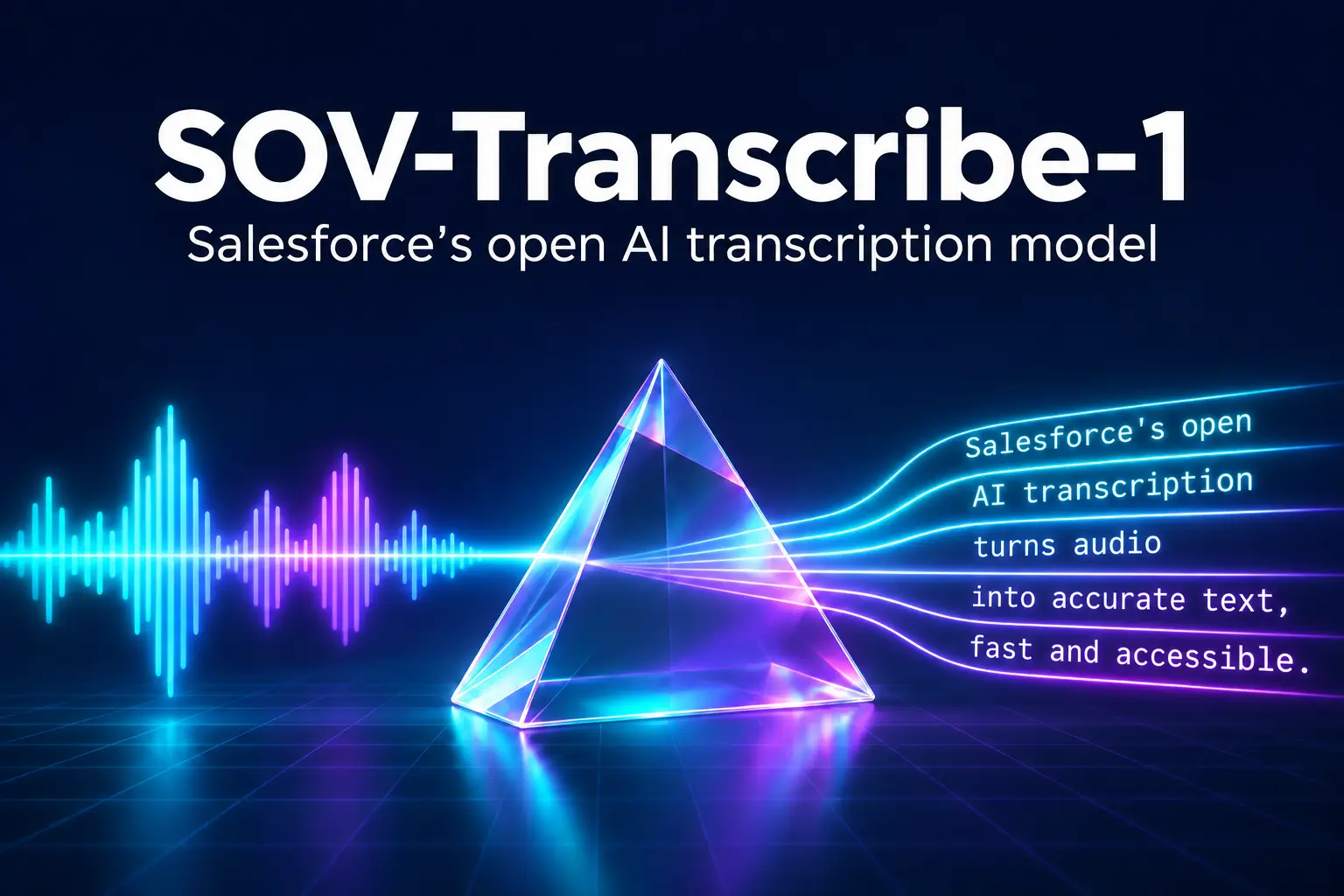
SOV-Transcribe-1 is a speech-to-text model built by Salesforce and published on November 12, 2026, on the team's official Hugging Face blog. It comes from Salesforce's Missionforce Sovereign AI group, which calls it its first open-weight speech-augmented language model.
The weights are public and the license is Apache 2.0: anyone can download it, use it commercially and modify it. Salesforce's goal is to let companies and developers build voice agents, dictation tools and call transcription while keeping audio on their own servers instead of sending it to an outside service.
It is a non-streaming model: it takes an audio file that has already been recorded and returns the text. It does not produce word-by-word captions while someone is talking.
How accurate is it: the numbers
SOV-Transcribe-1 is the most accurate open model on the independent Artificial Analysis leaderboard for non-streaming transcription, with an AA-WER of 2.3%. WER (word error rate) is the share of words the model gets wrong: lower is better.
| Open model | AA-WER |
|---|---|
| SOV-Transcribe-1 (Salesforce) | 2.28% |
| Voxtral Small (Mistral) | 2.77% |
| Nemotron 3.5 Transcribe (NVIDIA) | 2.81% |
Figures as reported by Salesforce in its launch post, consistent with the leaderboard. Salesforce also says the model ranks seventh overall, paid services included, and second of 23 systems on VoiceCodeBench, a test of how well models capture exact details such as phone numbers, emails and IDs (76.3% task success, as stated by the company).
How it works and what you can ask it
Under the hood, SOV-Transcribe-1 pairs the Whisper large-v3 audio encoder with a Gemma 4 26B A4B mixture-of-experts language model. It has 26.6 billion parameters in total but uses only 4.6 billion per token, which makes it faster than its size suggests.
What sets it apart from a classic transcriber is that it takes written instructions. According to the model card, you can ask it for:
- a verbatim transcript or a clean, written-form one;
- keeping or removing filler words such as "um";
- specific handling of punctuation, capitalization and numbers (for example digits instead of words);
- recognition of names and technical terms you provide, or a short description of the topic.
That last point matters: on a test set of financial earnings calls, Salesforce says giving the model the recording's keywords raises recognition of those terms from 71.9 to 96.8 points.
Requirements and limits
SOV-Transcribe-1 is free to download, but it is not a laptop tool.
| Item | What the model card says |
|---|---|
| Languages | English, French, German, Spanish, Italian, Portuguese, Dutch |
| Audio length | Up to 30 minutes (tested); expects 16 kHz mono |
| Mode | Recorded files only, no live transcription |
| Reference hardware | One 96 GB GPU (RTX PRO 6000 Blackwell) |
| Software | Transformers, or vLLM 0.32.0 with the bundled plugin |
| Stated speed | Up to 1,039 seconds of audio per second; a 30-second clip in 0.22 seconds |
The BF16 weights alone take about 53 GB (26.6 billion parameters at 2 bytes each). The card also flags a rare failure: the model sometimes repeats a character or phrase until it hits the token limit. The advice is to check for truncated or repetitive output and to split long recordings at pauses. The full technical report is listed as "coming soon".
Why an open model matters
Until recently, highly accurate transcription meant paying an online service and uploading your audio to it. With SOV-Transcribe-1 the best open result moves close to closed services: on the Artificial Analysis leaderboard the top system sits at 1.7% AA-WER, against 2.3% for SOV-Transcribe-1.
That is good news even if you never install the model yourself. Captioning, editing and meeting-note apps can adopt it without per-minute license fees, and competition between open models such as NVIDIA's Nemotron 3.5 and Mistral's Voxtral tends to push prices down. On the same front, ElevenLabs launched ElevenAI a few days ago, a dictation app built on its Scribe v3 model, which remains closed.
What it means for you
If you make videos, podcasts or courses, transcription sits underneath almost everything: captions, descriptions, chapters, articles drawn from a video.
- Cleaner captions and cuts. A transcript with fewer errors means fewer manual fixes to captions and cleaner cuts when you edit on speech. For a ready-made workflow that captions and edits automatically, see AI Editing Automation or the automatic AI editing page.
- One video, many pieces of content. The clean text of a long video turns into posts, carousels and emails. If you edit on your phone, CapCut Mobile Mastery shows you how to use automatic captions where you actually publish.
- Voice at the center. Transcription and synthetic voice go together: if you want a clone of yourself that speaks in your videos, there is Create your AI clone in 30 minutes.
The practical limit remains: to use SOV-Transcribe-1 directly you need a data-center GPU or a service that offers it. For a complete path to creating content with AI, there is The AI Creator System.
Frequently asked questions
Is SOV-Transcribe-1 free?
Yes, the weights are free to download from Hugging Face under the Apache 2.0 license, which also allows commercial use. The real cost is hardware: you need a GPU with a lot of memory or a cloud service.
Which languages does SOV-Transcribe-1 support?
Seven: English, French, German, Spanish, Italian, Portuguese and Dutch. Salesforce has not published separate error rates for each language.
Can I run SOV-Transcribe-1 on my own computer?
Not on a regular laptop. The weights take about 53 GB and the reference setup uses a 96 GB GPU. It is built for companies and services that host it on their own servers.
Does SOV-Transcribe-1 do live captions?
No. It is a non-streaming model: it transcribes recorded audio files up to 30 minutes long, but it does not produce text in real time while someone speaks.
How accurate is it compared with other open models?
On Artificial Analysis it has an AA-WER of 2.3%, the lowest among open models, ahead of Mistral's Voxtral Small and NVIDIA's Nemotron 3.5 Transcribe, both around 2.8%.
Read next