ElevenLabs Eleven Realtime: what v1 Mini and v1 Max are and what you can do with them
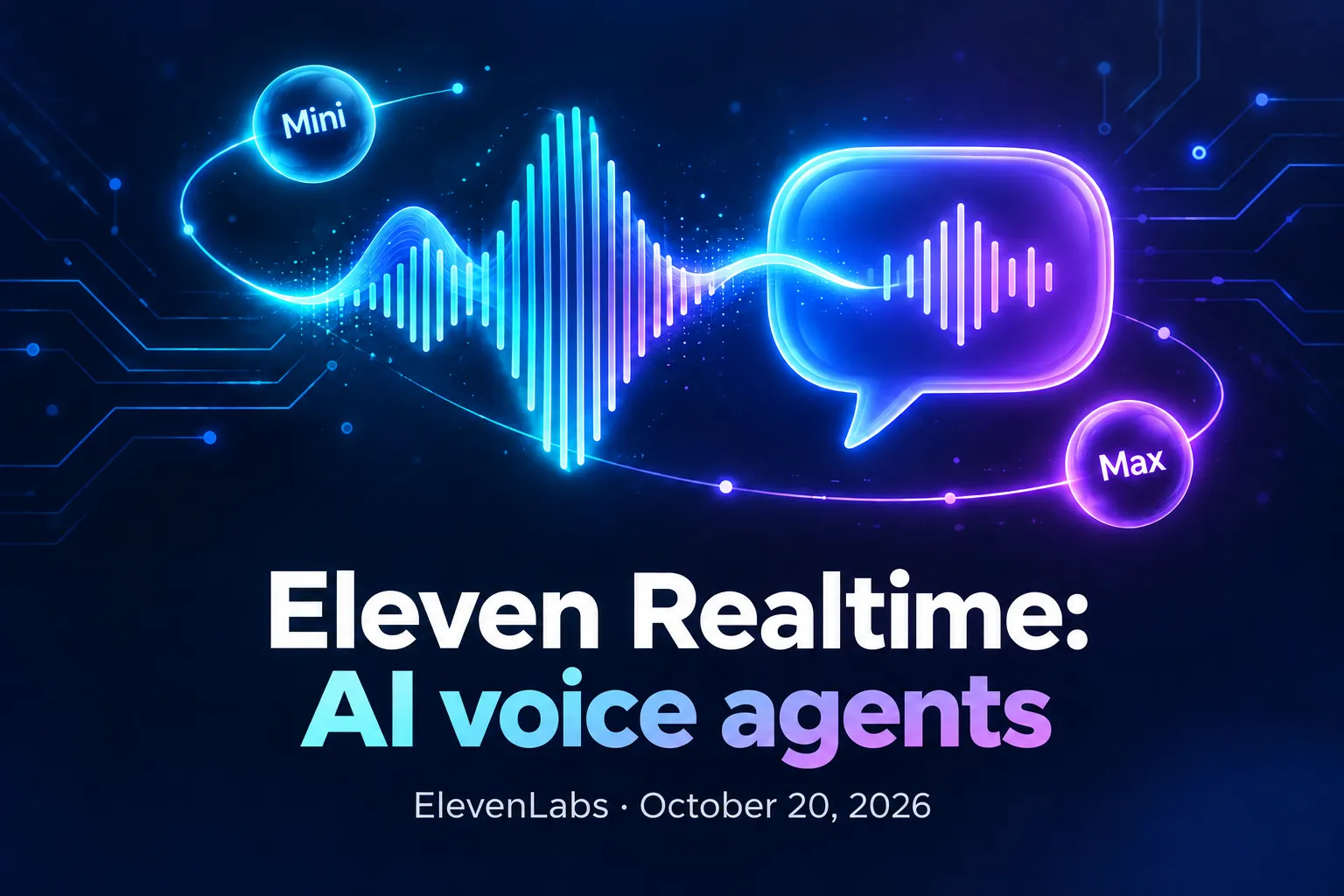
On October 20, 2026 ElevenLabs launched Eleven Realtime, a family of speech-to-speech models that listen, reason and answer out loud as a single system. There are two versions: v1 Mini for natural, low-cost conversations and v1 Max for complex tasks. Here is what they do, the numbers ElevenLabs reports, how to use them and what they change for anyone building voice assistants, characters or customer service.
Leggi questo articolo in italiano
What Eleven Realtime is
Eleven Realtime is a new class of speech-to-speech models from ElevenLabs: they take in a person's voice and reply by voice, handling the whole loop in one system. ElevenLabs announced it on October 20, 2026 in an official post written by Min Kim.
The problem it targets is a practical one. Until now, building a voice agent that sounds natural meant choosing and tuning many separate parts: speech recognition, voice activity detection, turn-taking, the language model and text to speech. With Eleven Realtime, the company writes, each model is a complete voice agent: recognition, turn-taking, the LLM and the voice are tuned end to end.
In practice, the agent itself decides how long to wait after a pause before answering, how to recover when the user interrupts and how to keep voice and response in sync. ElevenLabs puts it this way: you shouldn't have to become a configuration expert to build a voice agent that sounds natural. In the ElevenAgents platform those choices remain adjustable settings.
Eleven Realtime v1 Mini vs v1 Max
Two models are available at launch, both with more than 90 languages and access to the 17,000+ voices in the ElevenLabs library:
| Eleven Realtime v1 Mini | Eleven Realtime v1 Max | |
|---|---|---|
| Built for | Natural conversations at low cost | Complex tasks |
| Suggested uses | AI assistants, tutors, interactive characters | Customer support, lead qualification, multi-step workflows |
| Time to first audio | 0.62 seconds | 0.57 seconds |
| Big Bench Audio (spoken reasoning) | 75.9% | 98.8% |
| Full-Duplex-Bench (conversational dynamics) | 95.8% | 94.1% |
| Speech Agent Arena (human preference) | 988 | 998 |
| Tool-use tasks completed | 60.3% | 87.1% |
According to ElevenLabs, Mini "will be sufficient for most use cases"; Max is recommended when the agent has to follow a process, reason step by step and call external tools often, such as a calendar or a CRM. Interestingly, Mini beats Max on conversational naturalness (pauses, interruptions, turn-taking), while Max pulls well ahead on reasoning and tool use.
The benchmarks: what they actually measure
The numbers in the table are reported by ElevenLabs, which cites independent evaluations by Artificial Analysis on three public tests. Analytics India Magazine reported the same figures on October 21, 2026.
- Big Bench Audio asks 1,000 reasoning questions by voice and scores the spoken answer. This is where v1 Max reaches 98.8%.
- Full-Duplex-Bench measures conversational dynamics: pauses, turn-taking, interruptions and backchannels such as "mm-hm" or "right".
- Speech Agent Arena pits two models against each other in blind live conversations, judged by people on preference and task success.
ElevenLabs notes that accuracy and speed usually trade off: the models that score highest on Big Bench Audio take the longest to answer. The company says v1 Max does well on both. These figures are a useful guide, but they come from the vendor: before putting an agent in front of your customers, test it on your own real conversations and in your own language.
How to use it: ElevenAgents or the Realtime API
There are two routes, described on the Eleven Realtime product page.
- In ElevenAgents (recommended by ElevenLabs). Create an agent, or open an existing one, and pick v1 Mini or v1 Max from a dropdown: transcription, turn-taking and voice are already configured. The same agent can be deployed to phone, a website widget, WhatsApp and contact center platforms, with a knowledge base, guardrails, testing against scripted scenarios and conversation monitoring.
- Through the Realtime API. It is compatible with OpenAI's Realtime API: if you already have an integration, you change the endpoint and model name and keep the rest of your code. OpenAI's SDK works as is, but only over WebSocket, so a WebRTC integration has to move to WebSocket first. The Realtime API runs separately from ElevenAgents, so channels and the knowledge base are not included.
On the product page ElevenLabs also lists encryption in transit and at rest, support for SOC 2, HIPAA and GDPR compliance, EU data residency and a zero retention mode: details that matter if your agent handles customer data.
What it means for you as a creator working with voice and AI
Eleven Realtime is not a voiceover generator: it is for building something that talks with people in real time. For a creator or a small business, three uses stand out:
- An assistant that answers customers by phone or on WhatsApp. With v1 Max the agent can follow a process and check tools, for example availability. If you want to set up AI customer service without starting from scratch, Customer Care AI gives you the method and the scripts to start from.
- Qualifying leads before they reach you. ElevenLabs lists lead qualification among v1 Max's uses: the right questions and the sales process that follows are in AI Sales Machine.
- Interactive characters and tutors. v1 Mini is built for natural conversations with virtual characters and teachers: useful if you are building a course or a format with an avatar that answers out loud.
If instead you want your own voice and face speaking in your videos, cloning is still the way: read our AI clone guide and the HeyGen guide, then follow Create your AI clone in 30 minutes or let us do it with the 30-second AI clone video service. For the wider picture on conversational voice, read our pieces on GPT-Live-1.1 in ChatGPT and on the Claude Duet agent.
Frequently asked questions
When was Eleven Realtime released?
ElevenLabs announced Eleven Realtime v1 Mini and v1 Max on October 20, 2026, available right away in ElevenAgents and through the Realtime API.
Should I pick Eleven Realtime v1 Mini or v1 Max?
Mini for natural, low-cost conversations such as assistants, tutors and characters: ElevenLabs says it is enough for most use cases. Max for customer support, lead qualification and multi-step workflows with heavy tool calling, where in the reported tests it completes 87.1% of tasks versus 60.3% for Mini.
How many languages does Eleven Realtime support?
ElevenLabs says both models support more than 90 languages and a wide range of accents, and can use any voice in its library of over 17,000. Test it on your own real conversations before going live.
Can I use Eleven Realtime instead of OpenAI's Realtime API?
Yes, that is the point: it follows OpenAI's Realtime API specs, so you change the endpoint and model name and keep your code. Note that it works over WebSocket only, not WebRTC.
Read next