GPT-6.1 Terra: what OpenAI's new model that uses your computer actually does
On Monday, October 26, 2026 OpenAI released GPT-6.1 Terra, the mid-tier model in its lineup, built for everyday computer work: filling in forms, entering invoices, reading technical drawings, editing video. It costs half as much as its predecessor through the API and is already in ChatGPT Work and Codex. Here is what it really does, what it costs, who can use it and which numbers are only claimed.
Leggi questo articolo in italiano
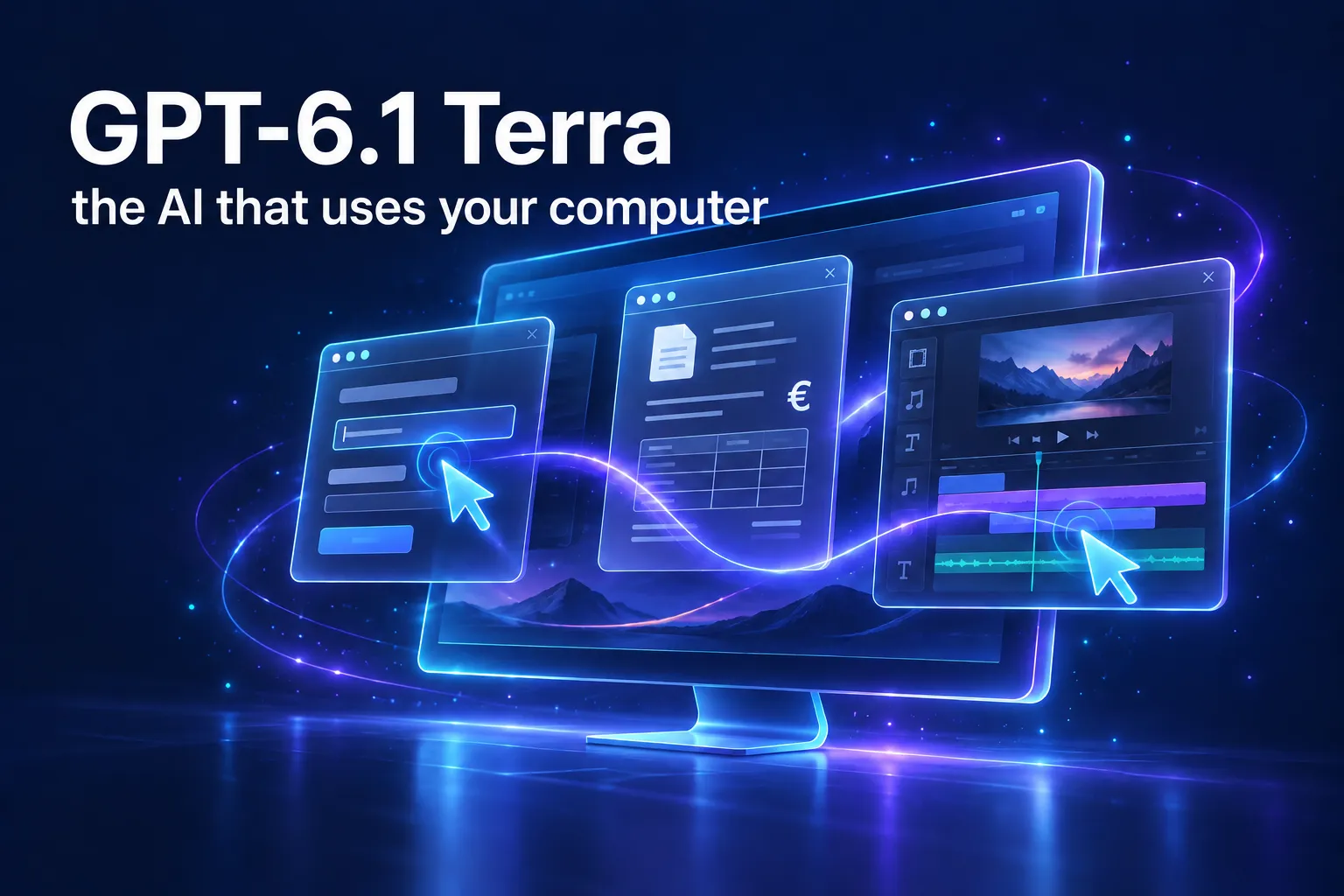
What GPT-6.1 Terra is and when it launched
GPT-6.1 Terra is OpenAI's new mid-tier model, released on Monday, October 26, 2026, which OpenAI describes as "a fast, efficient model that combines detailed visual reasoning and precise computer use." It replaces GPT-5.6 Terra, which had been left behind in September when OpenAI moved Sol and Luna to GPT-6, as 9to5Mac points out.
To find your way around, it helps to know OpenAI's current lineup, which has four model classes from cheapest to most powerful:
- Luna, the lightest and cheapest;
- Terra, the mid tier, the one just updated;
- Sol, more capable and more expensive;
- Astra, the flagship (currently GPT-6 Astra).
Terra is the workhorse: not the smartest model, but the one OpenAI pitches for repetitive everyday tasks, where speed and cost matter more than the last benchmark point.
What it does: computer use in plain words
GPT-6.1 Terra's main strength is computer use: the model reads the screen, understands what it is looking at and acts by clicking, typing and switching between applications, the way you would. The software does not need a dedicated integration: if an app works with a mouse and keyboard, the model can in principle use it.
The examples OpenAI gives, as reported by BleepingComputer and The Next Web, are very practical:
- filling in forms and automating repetitive desktop work;
- entering incoming invoices into accounting software;
- reading and interpreting technical drawings;
- editing video;
- drafting proposals and documents.
Image understanding also improves. In one test described by OpenAI, the model turned architectural drawings into a 3D model; in another, it logged an animated film shot by shot, with time codes, for a restoration team. These are examples the company picked: useful to understand the intent, not a guarantee of results on your own files.
For the hardest coding tasks, OpenAI still recommends GPT-6.1 Sol or GPT-6 Astra: Terra is built for volume, not for edge cases.
Pricing and availability: who can use it and what it costs
GPT-6.1 Terra has been available since October 26, 2026 to Plus, Pro, Enterprise and Edu users in ChatGPT Work and Codex, and to developers in the API as gpt-6.1-terra. The sources we checked do not mention ChatGPT's free plan.
| Item | GPT-6.1 Terra | GPT-5.6 Terra |
|---|---|---|
| Input tokens (per million) | $1 | $2 |
| Output tokens (per million) | $5 | $12 |
| Cached input (per million) | $0.05 | $0.20 |
| Average cost per task, max effort (Artificial Analysis) | $0.40 | $1.40 |
The $1 and $5 pricing is reported by BleepingComputer, The Next Web and Artificial Analysis; the predecessor's prices and the cost per task come from Artificial Analysis. OpenAI sums it up as half the price of GPT-5.6 Terra.
If you use ChatGPT on a subscription, per-token pricing does not affect you directly: it matters to anyone building automations and agents on the API, where a model that costs less at every step changes the math of a workflow that runs thousands of times.
The numbers: what OpenAI claims and what independent testing says
OpenAI claims GPT-6.1 Terra performs on par with GPT-6 Astra at a tenth of the per-token price and runs more than three times faster than Astra and Sol; independent testing by Artificial Analysis confirms a step forward, but a smaller one. Here are the figures claimed by OpenAI, as reported by BleepingComputer, 9to5Mac and The Next Web:
- Agents' Last Exam: 15 percentage points above GPT-5.6 Terra at medium effort, at about a third of the cost;
- Terminal-Bench 4.0 (command-line coding, max effort): 50.3% versus 21.5% for the predecessor;
- errors on trick questions (OpenAI's internal test): at the lowest effort they drop from 53.6% to 16.7%; at max effort they fall 18 points to 4.3%, close to GPT-6 Astra and GPT-6.1 Sol.
Artificial Analysis, which benchmarks models independently, published its results on October 26, 2026: at max effort GPT-6.1 Terra gains 6 points on its Intelligence Index over GPT-5.6 Terra, sits 4 points below GPT-6.1 Sol and 10 above GPT-6 Luna. Its hallucination rate on the AA-Omniscience test drops from 88% to 38%. According to the same analysis, the clearest jump is in terminal coding, while other gains are small.
In short: cheaper and more reliable than its predecessor, not at flagship level across the board.
What it means for you if you create content or work for yourself
GPT-6.1 Terra confirms where AI assistants are heading: not just answering in a chat, but doing the tedious computer steps for you, at a cost that makes them worthwhile even for small businesses. It is the same road as Anthropic's Claude Duet, introduced a few days earlier.
- Pick the tasks to delegate. Forms, invoice entry, recurring reports, renaming and organizing files: the use cases OpenAI mentions first.
- Write clear instructions. An agent that uses the computer needs step-by-step guidance: the goal, the checks to run and what not to touch.
- Always check the result. Even with fewer claimed errors, a model that clicks for you should be reviewed before anything is sent or paid.
- Pick the right model. Terra for volume, Sol or Astra for the hardest tasks.
For ready-made prompts and procedures to give ChatGPT or an agent, the AI Business Toolkit collects tools and prompts for everyday work; if you also use Claude, Claude Business OS covers emails, meetings, documents and numbers, and for customer messages there is Customer Care AI. If the part you want to automate is video editing, start with AI Editing Automation.
To stay on ChatGPT, also read about GPT-Live 1.1 and the new voices and our ChatGPT Images guide. For a complete method to create with AI there is The AI Creator System, and here is how we use artificial intelligence.
Frequently asked questions
What is GPT-6.1 Terra?
It is OpenAI's mid-tier model, released on October 26, 2026 to replace GPT-5.6 Terra. It is built for everyday computer work: it reads the screen and acts by clicking and typing in apps.
How much does GPT-6.1 Terra cost?
In the API it costs $1 per million input tokens and $5 per million output tokens. In ChatGPT it is included in Plus, Pro, Enterprise and Edu subscriptions, inside ChatGPT Work and Codex.
Is GPT-6.1 Terra better than GPT-6 Astra?
No. OpenAI claims performance similar to Astra on some tasks at a tenth of the per-token price, but still recommends Sol or Astra for the most complex coding. Independent tests by Artificial Analysis place it below GPT-6.1 Sol.
What does computer use mean?
It means the model uses a computer the way a person does: it looks at the screen, understands what is there and acts with clicks and text, moving between applications without dedicated integrations.
Is GPT-6.1 Terra available on free ChatGPT?
The launch sources from October 26, 2026 only mention Plus, Pro, Enterprise and Edu plans, plus the API. The free plan is not mentioned.
Read next


Sources checked on October 27, 2026
- BleepingComputer — OpenAI launches GPT-6.1 Terra with 3x faster AI agents, 50% lower pricing (26 ottobre 2026)
- 9to5Mac — OpenAI upgrades ChatGPT and Codex with new GPT-6.1 Terra model (26 ottobre 2026)
- The Next Web — OpenAI launches GPT-6.1 Terra, a cheaper model for everyday computer work (26 ottobre 2026)
- Artificial Analysis — GPT-6.1 Terra pushes the cost efficiency frontier (26 ottobre 2026)