Poppy 1.0: Sierra's standard that opens Shopify stores to personal AI agents
On November 13, 2026 Sierra released Poppy 1.0, the Personal Agent Protocol: a set of rules a company uses to tell a personal AI agent who it is, what the agent may do on its site and when it must ask the customer first. Shopify switched it on for every store, and Muse, Meta's AI agent, now looks for it first on every site. Here is how it works, what we checked ourselves and what it changes if you sell online.
Leggi questo articolo in italiano
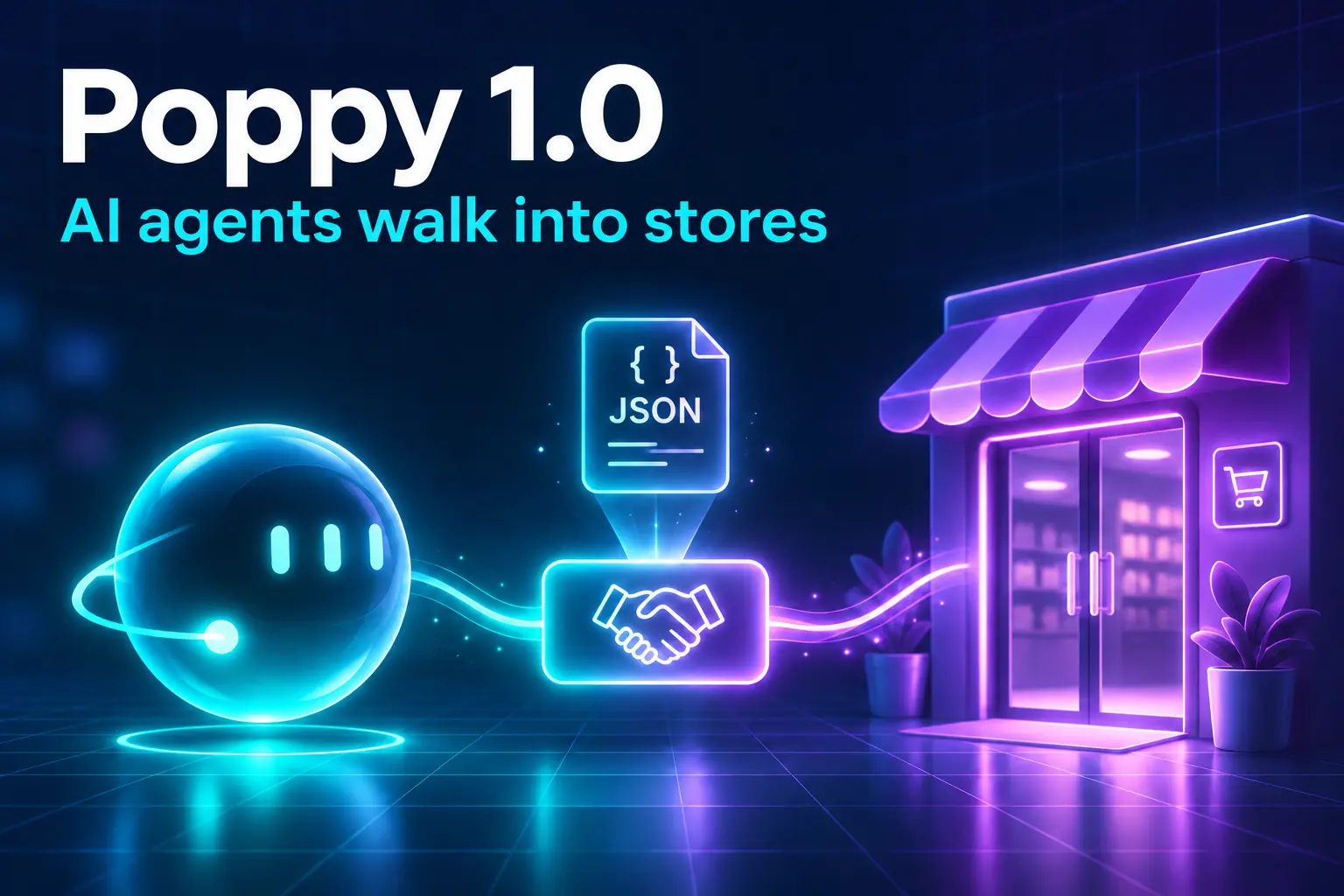
What Poppy 1.0 is and who built it
Poppy, the Personal Agent Protocol, is a publicly documented standard that defines how a personal AI agent introduces itself to a company and what it may do on its user's behalf. Sierra announced version 1.0 on Thursday, November 13, 2026 on its official blog, and the full specification is published at personalagentprotocol.org.
Sierra is the customer service AI company led by Bret Taylor, former co-CEO of Salesforce. As TNW notes, Sierra and Meta unveiled a first draft of Poppy in October. Over the following five weeks, partners tested the drafts against real websites, APIs and agents.
The problem Poppy tries to solve is easy to state. Today an AI agent visiting a site for you has to guess: it reads pages the way a person would, clicks around and hopes it gets things right. With Poppy, the company declares in a structured way who it is, which tasks it accepts, how to sign in and which actions need your approval.
How it works: the poppy.json file and the standards behind it
Every company that adopts Poppy publishes a JSON document at /.well-known/poppy.json on its own domain, and the agent reads it before doing anything else. According to the specification, the file lists the protocol version, organization details, access rules, the channels for talking to the company's own agent, the available APIs and any extensions.
Poppy does not reinvent everything. Sierra explains that it is largely built on existing standards:
| Standard | Its role in Poppy |
|---|---|
| OAuth | Customer sign-in and the permissions they grant their agent |
| MCP | Connecting the agent to the company's tools |
| OpenAPI | Describing the APIs the agent can call |
| UCP (Universal Commerce Protocol) | Product discovery, carts and checkout in stores |
Compared with the October draft, 1.0 lets companies adopt the protocol in stages, starting with the basics, and adds extensions for specific industries. The first is the commerce extension, co-authored with Shopify: the agent can shop as a guest or sign in to the customer's account, and it must ask the customer before certain actions.
One caveat: TNW and Shopifreaks report that the specification is still labelled a draft and could change in ways that break existing setups. The official 1.0 page, on the other hand, says that from this version on, minor updates should not break older agents.
Shopify, Meta Muse and more than 100 partners
The most concrete news is that Shopify switched Poppy on for every store on its platform: each store publishes its Poppy file automatically, and merchants do not have to configure anything. Poppy handles the first contact, meaning who the agent is and what it may do; carts and checkout are still handled by UCP, which Shopify stores already support by default.
We checked this ourselves on November 16, 2026: on the sites of two Shopify stores, Allbirds and Kith, the /.well-known/poppy.json address returns a real file. It contains a single permission that lets the agent prepare checkouts for the signed-in customer, while the buyer completes the purchase. The permission is marked as irreversible and as involving personal data. In those files the declared version is still 0.4, the draft that came before 1.0.
On the other side is Muse, Meta's AI agent: Poppy is on for all its users, and Muse looks for it first on every site it visits. According to TNW, more than 10 million people have set up Muse.
Sierra claims more than 100 design partners, 60 of whom joined with 1.0. Names mentioned include Affirm, Aflac, Stripe, Walmart, Wayfair, Salesforce, Zoom and Turkish Airlines. Only a few are actually live:
- Mercury: the agent can check balances and transactions, manage budgets and receipts, and start payments, which still go through the account's approval rules;
- Turkish Airlines: the agent checks fares, flight status and bookings and, for Miles&Smiles members, finds business-class upgrades that the customer approves before paying.
Limits and open questions
Poppy is a step forward, but it is not yet the universal standard for shopping agents. Keep three limits in mind as of November 16, 2026.
- Few live services. There are more than 100 partners, but TNW and Shopifreaks stress that only a small share are in production.
- Payments are still limited. In Shopify stores the agent prepares, it does not pay: the last step is yours. Turkish Airlines also says it is still working on letting customers complete purchases inside the conversation.
- Competing standards. Poppy is not the only attempt: TNW notes that Visa and Mastercard are building their own identity checks for agents, and that Amazon would rather shoppers use its own agent than Muse.
Then there is the question that matters most to sellers: how to tell a legitimate agent from one pretending to be. Poppy relies on OAuth and on the permissions chosen by the customer, who can change them over time.
What it means for you if you sell online
If you run a Shopify store, your site already speaks the language of personal AI agents today, with nothing for you to do: the point is to make sure what the agent finds is clear, complete and convincing. An agent does not look at photos with eyes: it reads product pages, prices, variants, shipping times and return terms.
Three practical things to do now:
- Check your file. Open
yourstore.com/.well-known/poppy.jsonin your browser and make sure it responds. - Rewrite product pages for someone reading on a customer's behalf: explicit details, no information hidden only inside images, FAQs with direct answers.
- Get your customer service ready for agents. Questions about orders and returns will increasingly come from an AI writing on behalf of a person.
If your store needs a rebuild or you do not have one yet, our eCommerce service builds it for you, while Website AI University teaches you to build sites with AI yourself. To answer customers with your own assistant there is Customer Care AI, and to organize daily work with agents you have Claude Business OS.
It is the same shift we covered with Businesses in ChatGPT and with the latest from Meta Muse: companies increasingly talk to their customers' agents, not just to customers. For a complete method on content and sales with AI there is The AI Creator System.
Frequently asked questions
What is Poppy 1.0?
It is version 1.0 of the Personal Agent Protocol, released by Sierra on November 13, 2026: a standard a company uses to tell a personal AI agent who it is, which actions it may take on its site and when it must ask the customer first.
Do I need to do anything if I run a Shopify store?
No. Shopify switched Poppy on for every store, and each store publishes its poppy.json file automatically. You can check it by opening /.well-known/poppy.json on your domain.
Can an AI agent buy from my store on its own?
As of November 16, 2026, in the Shopify stores we checked, the published permission lets the agent prepare the checkout, but the buyer completes the purchase. The standard also requires the agent to ask the customer before certain actions.
Which agents use Poppy?
The first major agent is Meta's Muse, which looks for Poppy on every site it visits. Sierra claims more than 100 design partners, but only a few services are live, such as Mercury and Turkish Airlines.
Is Poppy related to MCP?
Partly, yes. According to Sierra, Poppy is built on existing standards such as MCP, OpenAPI and UCP, with access handled through OAuth.
Read next