ChatGPT Business Hub: what Businesses in ChatGPT changes for people who sell online
On November 10, 2026 OpenAI launched Businesses in ChatGPT in beta. With the ChatGPT Business Hub a company can claim its profile, keep its details and products current and see how often it gets mentioned. In the US, some online stores can also publish a Business Agent that talks to customers. Here is how it works, who can use it and what it means for you.
Leggi questo articolo in italiano
What Businesses in ChatGPT and Business Hub are
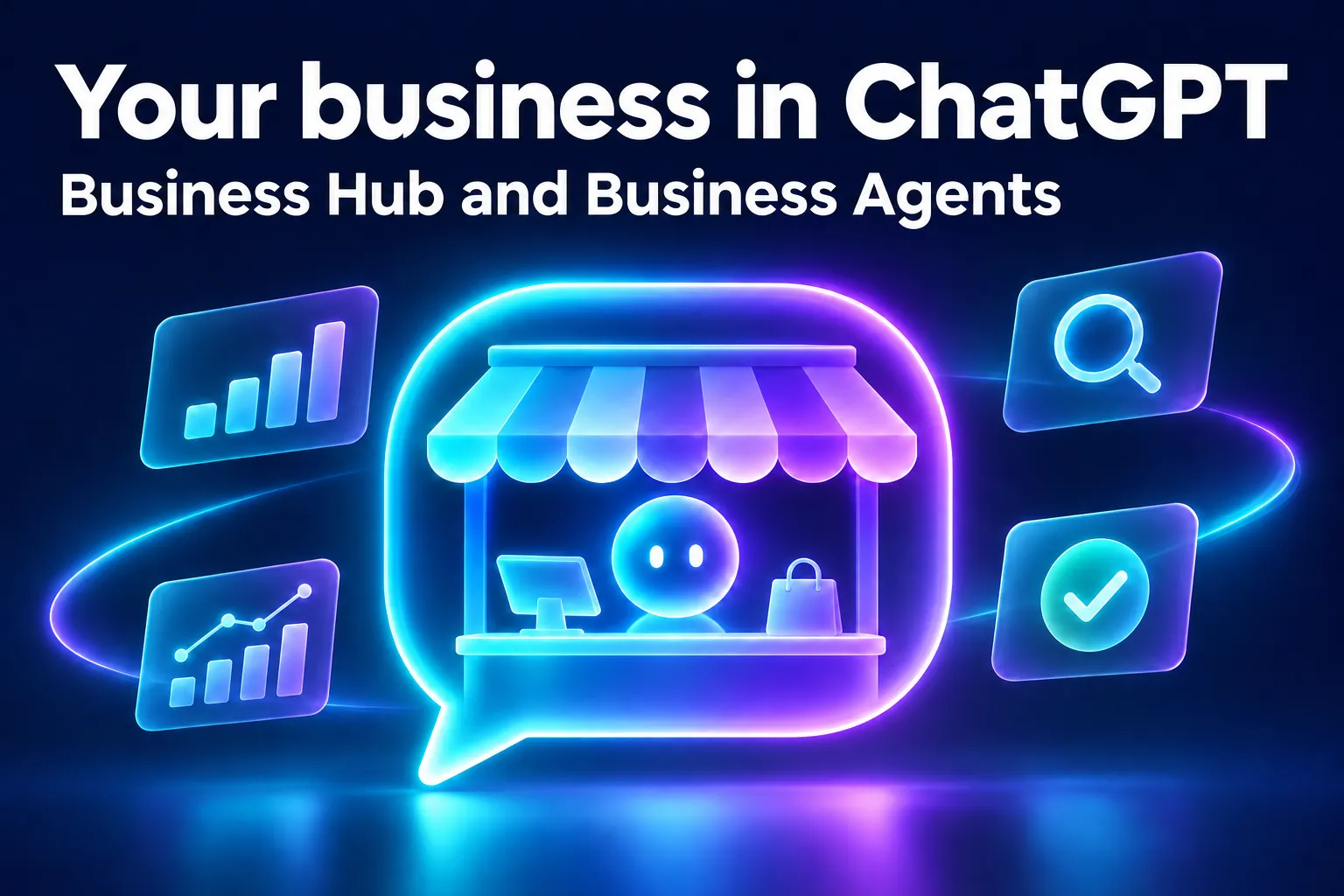
Businesses in ChatGPT is OpenAI's program that lets companies manage how they show up inside ChatGPT: the ChatGPT Business Hub is where you claim your profile, update your information and read mention data, while Business Agents are agents that talk to customers on the company's behalf. OpenAI announced it in beta on November 10, 2026 in an official post, describing it as a new way to reach the 1.2 billion people who use ChatGPT every week (a figure stated by the company).
The easiest comparison is a business listing on Google: instead of letting the model piece together who you are and what you sell, you give it current information yourself. Once verified, a business can correct its key details and add self-service product feeds with pricing and availability.
OpenAI calls the launch "an early step" and says it plans to expand the program to more markets and business categories over time, with tools for organizations that have more complex needs.
What data it shows: mentions, clicks and discovery topics
Business Hub shows aggregated data on how people encounter your business in ChatGPT: number of mentions, clicks to your website and "discovery topics", the recurring themes of conversations where ChatGPT cites your site. You don't see individual prompts or chats: OpenAI says insights only appear when there are enough conversations to pass certain thresholds.
An OpenAI spokesperson told Digiday a few details the official post leaves out:
- for a local business a mention counts when ChatGPT shows a result for that location; for an online business it counts when ChatGPT references the website;
- just naming the brand doesn't count as a mention;
- clicks are clicks on links from supported ChatGPT surfaces, not completed visits or purchases;
- share of voice against competitors isn't part of this beta.
According to an agency executive quoted by Digiday, the chart covers the past 7 or 28 days. It is the first data coming straight from ChatGPT, while AI visibility tools (so-called GEO) have so far relied on estimates and simulated prompts, as Trending Topics also points out.
Business Agents: the agent that talks to customers
A Business Agent is an agent built inside ChatGPT from a company's instructions and product feed: when a user sees the business in an answer, they can open its profile and start a separate, clearly labeled conversation with the agent. Someone comparing two products, for example, can ask about the differences and which one fits their needs.
The key points, from OpenAI's post and from what Benji Shomair, OpenAI's VP of monetization, told Digiday:
- availability: for now only eligible ecommerce and online service businesses in the US;
- no custom agents: "We aren't allowing folks to bring their own agents," Shomair said; the agent is built inside ChatGPT;
- checkout: when the customer is ready to buy, the agent sends them to the business's own site;
- privacy: the business can't read transcripts of chats with its agent, only the themes;
- advertising: the agent can be sponsored and used as the destination for ChatGPT Ads; sponsored placements are labeled and kept separate from answers.
Shomair described the business agent as the "organic" experience and the sponsored agent as the paid one, with the same agent behind both. Agents that act on their own are a theme of recent weeks: we also covered Perplexity Teammates and Meta Muse's real-time voice.
Who can use it, what it costs and what applies in Europe
Any eligible business located in a country where ChatGPT is available can claim its profile in Business Hub, Europe included; Business Agents, however, are limited to the United States for now. Existing OpenAI Enterprise customers and advertisers can go through their OpenAI representative.
| Item | Status as of November 12, 2026 |
|---|---|
| Announcement | November 10, 2026, in beta |
| Business Hub | Eligible businesses wherever ChatGPT is available |
| Business Agents | Eligible US ecommerce and online service businesses |
| Shopify | Connect the store from Business Hub or the Shopify admin |
| Price | Free for now (Digiday); ads are paid separately |
Shopify merchants get a shortcut: they can connect their store from Business Hub or the Shopify admin to streamline verification, and eligible products are already in ChatGPT through Shopify Catalog. On pricing, Shomair told Digiday the tools are free "for now" and didn't rule out a paid model later. He gave no timeline for other countries.
What it means for you if you sell online
If you run an online store, a service or a local business, the most useful thing to do right now is claim your profile and check that your details, prices and products are correct: it's free and gives you, for the first time, real numbers on how often ChatGPT cites you.
Don't expect miracles, though. Shomair was explicit: claiming a business "should not have an impact" on how often ChatGPT recommends it, because answers must stay objective. Clearer information can still help ChatGPT surface you in the right conversations. So a clear website, complete product pages and content that answers real customer questions still matter most: if your site needs rebuilding, the Website AI University course teaches you to build it with AI, or you can hand it to our ecommerce service.
The Business Agent is also a preview of where customer support is heading: automatic answers on products, sizes and prices, then a handoff to your site to close the sale. You can get ready today on your own site and channels with Customer Care AI and turn those conversations into sales with AI Sales Machine. For a complete path on using AI to create and sell, there's The AI Creator System, and our AI guides help you find your way among the tools.
Keep in mind: Business Hub data covers ChatGPT only, not Gemini, Perplexity, Claude or Google's AI Overviews. For visibility on other AI assistants you still need other tools.
Frequently asked questions
What is the ChatGPT Business Hub?
It's the space OpenAI launched in beta on November 10, 2026 where a business claims its profile in ChatGPT, updates its details and product feeds, and sees how many mentions and clicks it gets and which topics it's cited for.
Can I use Business Hub outside the US?
Yes: OpenAI says any eligible business located where ChatGPT is available can claim its profile. Business Agents, however, are limited for now to eligible ecommerce and online service businesses in the United States.
How much does Businesses in ChatGPT cost?
According to Digiday, Business Hub and agents are free for now and OpenAI hasn't ruled out a paid model in the future. Sponsoring your agent as a ChatGPT Ads destination is paid advertising.
Does claiming my profile make me show up more in ChatGPT?
No, according to OpenAI: Benji Shomair said claiming a business should not change how often it appears. Up-to-date information can still help ChatGPT surface it in more relevant conversations.
Can a business read my chats with its Business Agent?
No. OpenAI says it doesn't share users' conversations or Business Agent chats with businesses: they only see aggregated data and themes, above certain volume thresholds.
Read next